


I think by now, reading my articles, you will have realised that the concept of ‘this stuff only works for big companies’ is, in 90% of cases, hogwash.
‘Getting your work in order’ is one of those things that anyone should do.
Think about the last time you looked up an important piece of information in a group chat, when you needed a graphic hidden in some drive or attached to some email, or when a project dragged on for weeks without a clear delivery date. Those are all occasions when you lost time (and money) due to confused management.
In the small business world, it is often thought that flexibility means fewer rules and more freedom. But without a minimum of structure, work turns into chaos, with tasks getting lost, people not knowing what to do and customers waiting for answers that nobody has.
Corporate culture also depends on this: putting order, creating processes, measuring and optimising resources. And (we repeat again) this is not only true for companies as big as Microsoft, it also applies to the company with three employees.
In this article we will see why you always need a minimum of organisation, what problems you can avoid by adopting clear rules and how to do it without going crazy.
The most common problems in small businesses (and their consequences)
- If you think “a little confusion is normal,” take a look at these problems:
- Everyone does everything and no one does anything → Poorly assigned tasks, overloaded people and others who don’t even know where to start, projects waiting for the go-ahead from who knows who.
- Vague or non-existent deadlines → If “I’ll do it when I have time” is the norm, you risk postponing indefinitely.
- Information scattered everywhere → Chat, email, voice notes, phone calls, loose sheets: when you need a piece of data, the treasure hunt begins.
- Useless meetings and uncertain decisions → “Let’s talk about it quickly tomorrow” translates into a meeting that ends with more questions than answers.
All of this translates into wasted time, delays and frustration, as well as increasingly impatient customers. And wasted resources (because always remember that time is also a resource. And if you spend an hour looking for a file hidden in an email attachment, you are throwing away the economic equivalent of an hour’s work).
The benefits of having well-defined rules and processes
Adopting a few clear rules makes a difference:
- You work less, you get more → Every task has a manager and a deadline.
- Less stress, more results → Nobody has to remember everything by heart or be reduced to doing the job at the last minute.
- Clear and fast communication → You know where to find information without having to write a thousand messages.
- More time for things that matter → No unnecessary rework or meetings that could have been an email.
- Less wasted time and resources → reworking and wasted time… are costs.
How to start creating rules and processes without complicating life
A. Make life easier for everyone by using shared management tools
The important thing is not which tool you use, but that you use it consistently. Some tools that can help you:
- Google Workspace (Docs, Sheets, Drive)→ To collect and share documents and tasks.
- Trello / Asana / Notion → To organise work visually and intuitively.
- Miro → For brainstorming and mapping ideas.
- Slack / Microsoft Teams → To reduce emails and make communication more effective.
‘YEEEEHHHH but these tools cost money! and my company is small and cannot afford these tools’.
Point 1. You will be surprised to learn that most of these tools have a free version that will probably be fine for a small company
Point 2. When you think about how much a tool costs, think also about how much it costs not to use it and blow a project or manage it in an inefficient way
…and then I’ll tell you another thing: in the worst case scenario, pen and paper cost very little and for managing most personal tasks they work just fine.
B. Simple methods for organising work
1. Kanban – visualise the work
Sounds difficult? It is as difficult as taking an order in a restaurant: the waiter goes to the table, takes the order from a customer and brings it to the kitchen. The cook takes it and puts the dish into processing. When the dish is ready you take the dish to the customer. End.
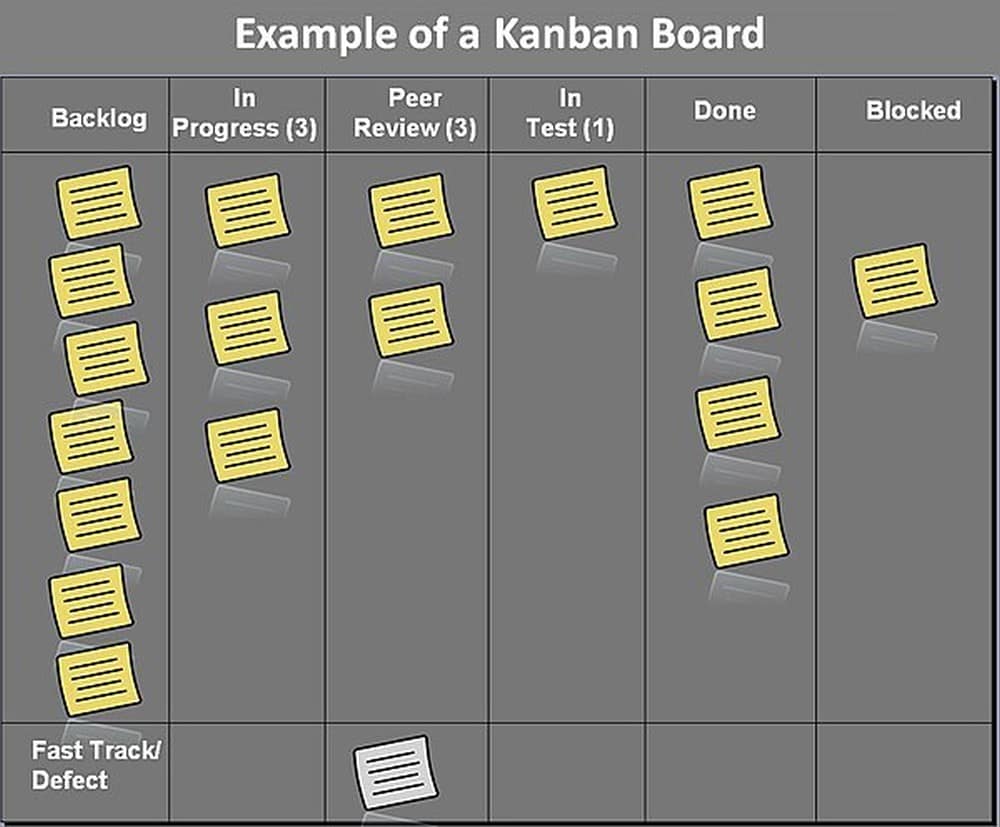
- Use three columns: To Do → In Progress → Completed.
- You can use Trello, Asana or even a blackboard with post-it notes. Or even an excel sheet.
- Knowing who is doing what helps to avoid overlapping and confusion.
2. Eisenhower Matrix – Do the right things
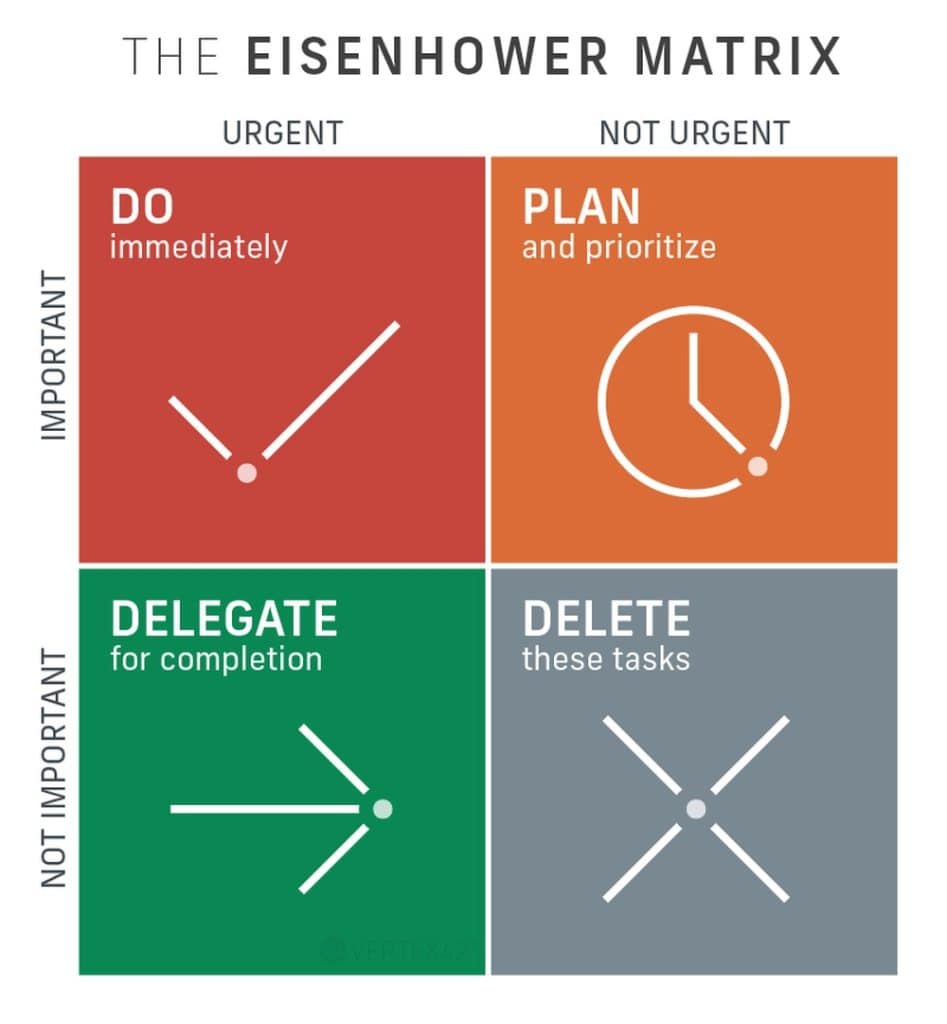
If everything seems important, nothing really is. This matrix helps you to distinguish what is really important:
- Urgent and important → Do it now
- Important but not urgent → Plan it.
- Urgent but not important → Delegate.
- Neither urgent nor important → Forget it.
3. Time Blocking – Protect your time
- Allocate precise time slots to precise activities. If you have allocated a slot to a certain activity, do not change plans.
- No multitasking: one task at a time.
- You can use Google Calendar to view your blocks of work.
- If you don’t want to use an online calendar, buy an agenda and a pen. And use them.
C. Define a few but clear operational rules
What do we have to decide?
- How do you assign a task? → Who assigns it and where do you track it.
- Where is the information located? → Define one centralised space.
- How to communicate? → Less WhatsApp, more structured tools.
- How to manage deadlines? → Realistic and shared dates.
D. Create a routine for the team
- Quick and focused meetings → it is absolutely not true that meetings have to last hours. In most cases 10 minutes is sufficient to align and clarify tasks. But only if these 10 minutes are very focused! During meetings avoid flying off the handle and talking about things that are unnecessary at that moment. What is the focus of the talk? Always keep that in mind and concentrate on that topic.
- A single point of information gathering → No more hunting for documents! Define one point where all information is channelled! Project sheets, shared (and sorted) drives, databases, paper files… decide on the best tool for you; it doesn’t matter which one, it matters that you decide on it and that you use it.
- Involve everyone in improvement → share continuous feedback to optimise the working method. If a project does not go as hoped, it is not the time to shout in each other’s faces, it is the time to critically (and SELF-critically) analyse what went wrong, so as to improve the process and prevent that problem from happening again.
You don’t have to become a project manager to get your work in order. All it takes is a few clear rules, tools used judiciously and the will to stop always chasing things at the last minute.
Getting organised is not a luxury, it is a necessity. If you want to grow your business, start by putting things in order. You will thank yourself later!