

The scene is this: an entrepreneur sits in front of a marketing agency and says “I want to redo the website”. Or: “I need a Facebook campaign’.
The agency nods, detaches the invoice and starts with the project. A month later, the site is online. Beautiful, modern, with elegant animations and perfect text. Or the Facebook campaign is on: eye-catching banners, precise targeting, everything done by the book.
And then what?
And then nothing happens.
Visits to the site? The usual. Sales? Same as before. The campaign? A few clicks, but no real impact.
The problem? Doing things without a strategy.
Why the isolated approach is wrong: The problem with thinking in terms of single activities
Thinking of marketing as a series of isolated activities is the worst mistake a company can make. A website, an advertising campaign, a newsletter… are tools, not strategies. And a tool without a strategy is just a useless cost.
Making a site is useless if it is not integrated into a broader strategy. The same applies to ads, to social, to any communication activity. Because marketing is not a matter of single actions, but of interconnected activities that are decoupled from precise objectives..
When a customer interacts with your brand, they do so on multiple channels and at multiple moments: maybe they discover you on Instagram, then they read a review on Google, then they visit your site, then they subscribe to your newsletter… and only then, perhaps, do they buy. If each piece of this journey is disconnected from the others, you are throwing away money and opportunity.
So, the next time someone asks you “Will you redo my site?”“, the right answer is: “yes, if it makes sense within your marketing strategy.”
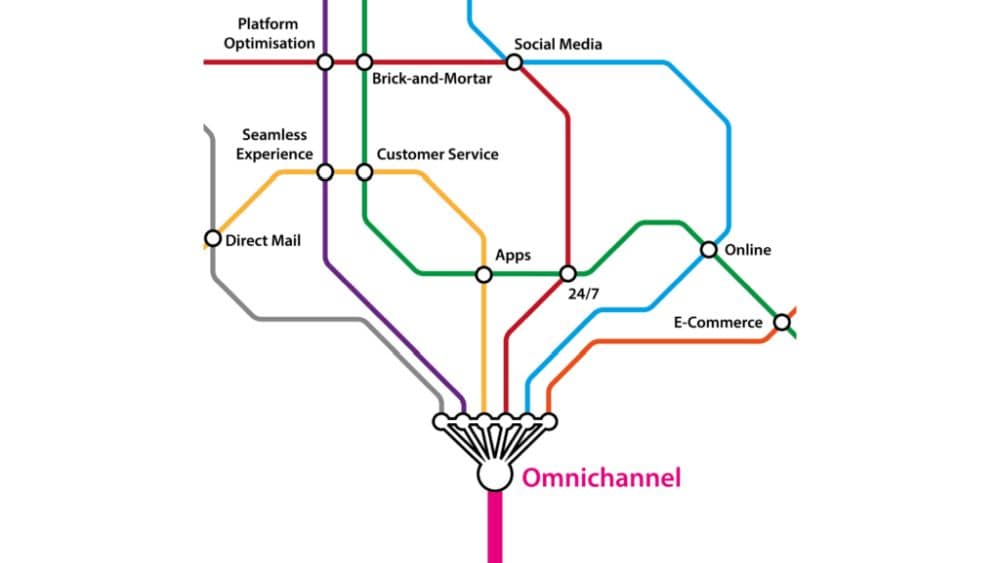
Or at least, that is what you should do if you are a consultant.And practically speaking, if you understand this, you have understood the concept behind omnichannel marketing, an approach that does not just put a site online or launch a campaign, but encompasses a coherent communication ecosystem, in which each action makes sense and works together with the others to achieve a clear objective.
Start with objectives
If there is one thing that companies should learn once and for all, it is this: marketing is not about performing tasks, but about achieving goals.
Almost always, when talking to customers, one starts with tools and actions (“Let’s make the site!”, “Let’s launch a campaign!”) without first asking why. This approach is like starting a journey without knowing the destination: you risk going round in circles, burning up budgets without getting concrete results.
The right questions to ask yourself before any action
Before starting any activity, you must stop and answer these questions:
N.B. In brackets you will find ‘technical’ terms that you can use in case you want to look up online and study specific topics.
Who is your intended audience?
- Who are your ideal customers? (study the buyer personas)
- What problems/desires do they have and how does your product/service solve them? (use the empathy map and the primary and secondary data sources)
- Where do they inform themselves? Which channels do they use? (find ‘touching points’)
What is the goal of communication?
- Do you want to make yourself known to people who do not yet know you exist? (branding, lead generation)
- Do you want to retain those who have already bought from you? (customer satisfaction, customer retention, customer lifetime value)
- Do you want to increase online sales? (promotions, usability, churn rate, funnel study)
What messages do you want to convey?
- What is your differentiating value compared to the competition? (unique value proposition)
- What kind of language and tone of voice will you use? (tone of voice, call to action)
- How does the message evolve according to the customer’s level of awareness? (study of the customer journey)
Which channels are most effective in reaching the target audience?
- If your audience does not use TikTok, why invest there? (viral marketing, influencer marketing)
- If your business is local, does it make sense to focus only on digital or do you also need a mix with offline actions? (integrated strategies, integrated marketing)
- At what moments does the customer interact with your brand? (buyer behaviour study)
How do we measure success?
- Which metrics really matter? (identification of KPIs and distinction with vanity metrics)
- Conversions? Number of contacts acquired? Increase in brand awareness?
- If you don’t measure the results, how can you tell if the strategy is working?
The AIDA model: a tool for creating an effective communication funnel
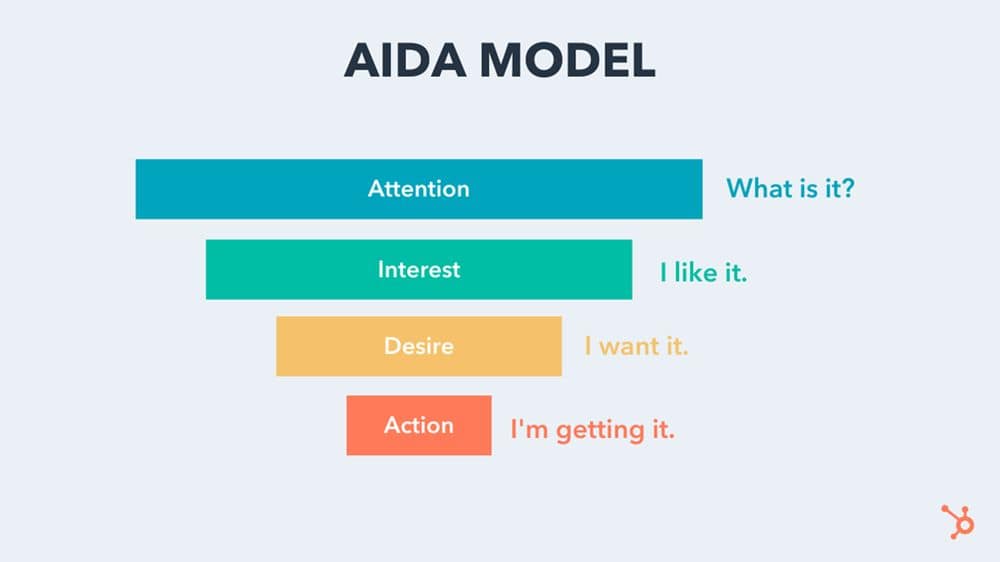
There are many frameworks and templates for creating effective communication plans. Models that allow us to guide customers from first contact to purchase. Among the many, I like the AIDA model: one of the most solid, intuitive and effective structures for building communication that really works.
AIDA stands for:
- Attention (capture attention)
- Interest (maintain interest)
- Desire (stimulate desire)
Action (drive to action)
Let us see how to apply it to an omnichannel strategy.
1. Attention: capturing attention
Thanks to social media, we live in a world where people are bombarded with information. If you don’t grab their attention in the first few seconds, you’re out of the game. The attention threshold today is very short: think of the communication on Tik Tok, Instagram reels or Youtube Shorts: we have to be immediate!
How to capture attention?
- Strong, clear headlines: A well thought-out sentence can make the difference between a post being ignored and a post being read.
- Impactful visuals: An effective image, a short and catchy video, a design that stands out.
- Relevant content: You have to talk about something that really interests your audience, otherwise you are background noise.
Leverage three elements: Pains, Needs and Wishes.
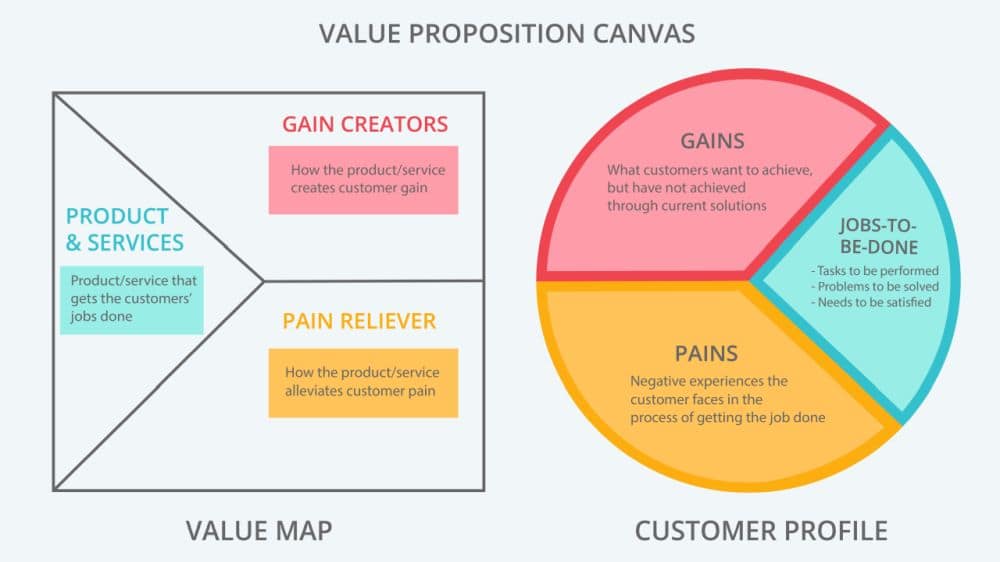
What problems or concerns (Pains) does your customer have? What does your customer need? What does your customer want (Wishes)?
Be the solution!
2. Interest: maintaining interest
Having your audience’s attention is the first step, but it is not enough. If nothing happens after seeing your content, you have missed an opportunity.
How to maintain interest?
- Storytelling: People are not passionate about numbers, but about stories.
- Valuable content: Guides, insights, practical examples. You must offer something useful.
- Active involvement: Questions, polls, open discussions. The public must feel involved.
3. Desire: stimulating desire
Now the customer knows that you exist and that you could be useful to him. But why should he choose you and not one of your competitors? This is where desire comes in.
How to create desire?
- Social proof: Reviews, testimonials, secure payment systems, certifications, case studies. If others have done well, the public will trust them more.
- FOMO (fear of missing an opportunity): Time limited offers, limited quantities, exclusive benefits.
- Customisation: Show that your product is perfect for the customer’s specific need.
4. Action: pushing for action
The audience is interested, the desire is high. Now the last step is needed: get them to do something.
How to achieve concrete action?
- Clear and immediate CTAs (Call to Action): “Find out more“, “Book now“, “Get a free quote“.
- Simplify the process: If a potential customer has to fill out a thousand forms or search for where to buy, you will lose them.
- Reinforce the value: Remind them of the benefits they will gain by acting now.
AIDA and omnichannel marketing
The beauty of the AIDA model is that it can be applied to any channel: social media, email marketing, advertising, website. But for it to really work, it must be integrated into a coherent strategy.
The AIDA model is a great tool to design communication on each individual channel but each of these channels must be systemised with the others and must be part of a broader strategy!
If you capture attention on social but the site is slow or unclear, you lose everything. If you create desire with an advertising campaign but the audience cannot find credible reviews, you lose trust. Each element must work with the others.
Adapting communication on three levels: channels, customer journey and market segments
One more thing must be made clear: communication cannot be the same for everyone, at all times and on every channel.
We often only refer to market segments and channels, but there is more to it than that. To simplify, we try to group everything into three basic levels of flexibility:
- In space: different communication channels
- In time: different stages of the customer journey
- In subject: different market segments
1. In space: different communication channels
Each channel has its own language, audience and rules. Legal issues change (related to country, business sector, privacy management, internal platform rules), the media supported (text, video, images, audio), profiling techniques change, the tone of voice changes (often related to audience demographics) and much more.
Each channel must be designed to create a message in line with it.
2. Over time: different stages of the customer journey
A customer is not always ready to buy. The path that leads him from brand discovery to loyalty consists of several stages, and each stage requires different communication.
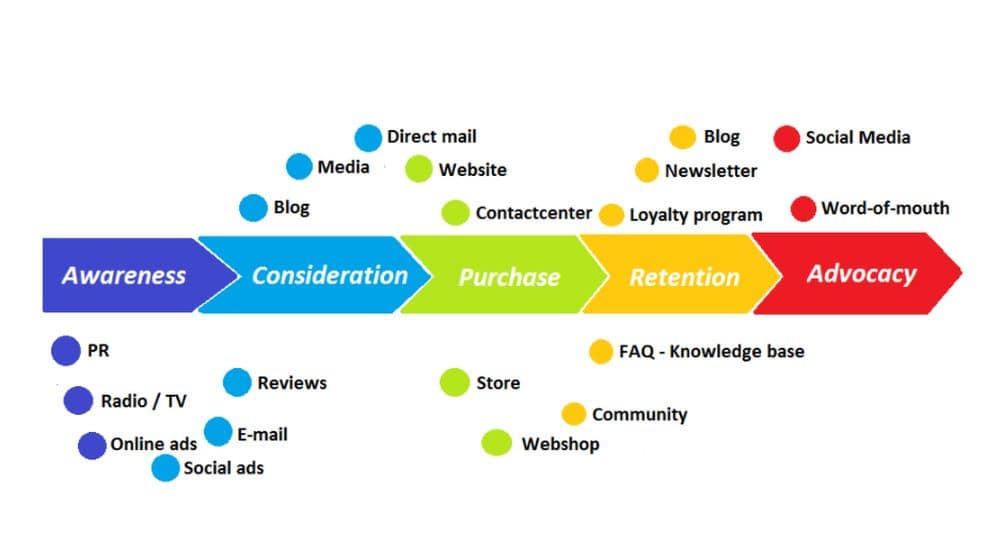
The 5 stages of the customer journey and how to communicate at each one
Awareness : That moment when the customer discovers the brand.
- Objective: to get noticed and explain the problem that the product solves.
- Channels: social media, advertising, SEO (informative articles).
Consideration (evaluation) : That moment when the customer looks for solutions
- Objective: to demonstrate value, trust and to differentiate oneself from the competition.
- Channels: email marketing, webinars, video tutorials, case studies, testimonials, reviews.
Decision : That moment when the customer is ready to buy.
- Objective: to reduce barriers to purchase and incentivise action.
- Channels: optimised product pages, reviews, free trials, time offers.
Retention (loyalty) : i.e., that moment when the customer has bought, but must stay with you
- Objective: to create a lasting relationship and increase value over time.
- Channels: community, customer service, loyalty programmes, exclusive content.
Advocacy (word of mouth and recommendation) : That moment when the customer is so satisfied with you that he or she becomes a brand promoter.
- Objective: to turn satisfied customers into brand ambassadors.
- Channels: referral programme, social proof, incentivised reviews, user-generated content.
3. In the subject: different market segments
Not all customers are the same. Different people have different needs, motivations and behaviour. Talking to everyone in the same way means not really talking to anyone.
Segmentation and customisation
To communicate effectively, one must divide the audience into homogeneous segments and tailor messages to each group. It can be useful to identify different buyer personas to identify the model customers in each segment.
Eh but then it all becomes more complicated and expensive
Activities such as the one I have described are certainly more complicated than “shall we make a new site for the company?”. But how much does that cost?
The right question is another: how much does it cost you not to do it?
- Both for an opportunity cost argument (i.e. the value of the best alternative you give up when making a decision. In other words, it represents the benefit lost by choosing one option over another).
- Both for a discourse related to wasting resources on activities that do not bring results.
This is what happens when you hear entrepreneurs complaining:
“I spent thousands of euros to redo the site, but it didn’t bring me any customers.”
“We did Facebook Ads, but after the campaign everything went back to the way it was.”
“We opened Instagram, but nobody follows us.”
If these tools do not work, it is not because they are wrong per se, but because they have been used without a strategy.
So what is the alternative?The alternative is simply to SMIT thinking of the various activities as an end, but consider them as tools that enable the achievement of high-level strategic goals!