

A “Customer” is not such right from the start. At first he is simply a person who has probably never heard of us, our products, our services, our brand.
Before he turns into a customer, he will have to go through a series of steps. And if you have read previous articles on Funnel Marketing, this metaphor of “steps” will be quite familiar to you. If you haven’t read them, read them (Part 1 and Part 2)
What I’m about to tell you today is another application of Funnel analysis, the one that is used to analyze how a person who barely knows us, can become a customer.
What is the “Customer Journey?”
The “customer journey” is the path a consumer takes from the beginning to the end of his or her involvement with a brand, product or service. This journey represents the set of interactions and experiences a customer goes through during the purchase decision process, from the identification of a need or desire to the actual purchase and beyond.
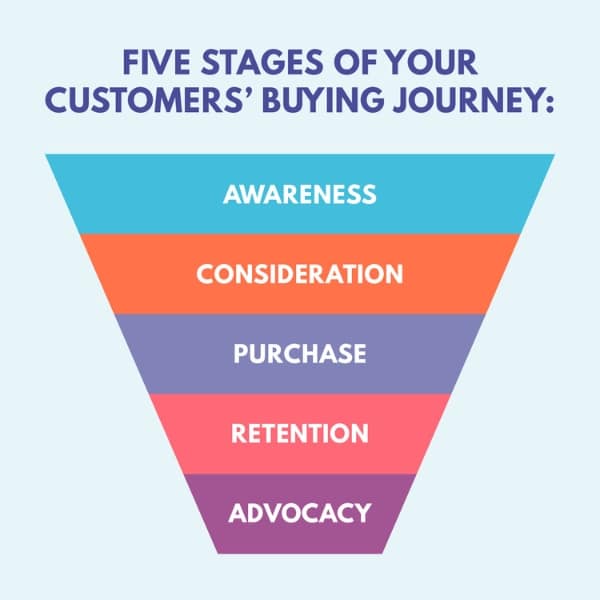
Generally this “journey” is represented as divided into 5 stages:
- Awareness
- Consideration
- Purchase
- Retention
- Advocacy
and not even on purpose, these 5 phases, are represented as a funnel! A fluke? Absolutely not! If all the people who know us were also our customers, that would be wonderful, but you know very well that this is not the case, and the number of people who know us is larger than the number of people who will consider us, which is larger than the number of people who will buy… etc. Funnel.
Let’s start by understanding the 5 phases, and then we’ll figure out how to analyze them from a Funnel perspective.
The 5 Stages of the “Journey”
Awareness
Consumers are aware that they can find in a product/service the solution to their problem or the answer to their need.
Consideration
This is the stage when the consumer has to choose among the different options available to him. An important role is played by the characteristics of the product/service (value proposition).
Purchase/Decision:
After evaluating the different proposals in the market, the consumer makes his final decision and proceeds to purchase. It is very important that the consumer can proceed with the purchase as easily, quickly and safely as possible, without any obstacles: any interruption, in fact, could make him rethink his decision and turn to a competing company.
Loyalty
Refers to a company’s ability to “retain” existing customers. It is the stage where a relationship with the customer must be built and loyalty created. Different tools can be used such as: loyalty programs, e-mail marketing activities with personalized offers, up-selling and cross-selling proposals, etc.
Advocacy
This is the stage when we have convinced and satisfied the customer to such an extent that he or she becomes our ambassador: someone who will talk about us and our service in a positive way to other people, feeding our reputation in a positive way.
And so, this funnel?
As we have already seen, being able to build and analyze a funnel means being able to define steps (and here, the 5-step Customer Journey model has already done that for us) and then we need to define goals and KPIs for each step!
So let’s try to understand how to analyze the Customer Journey by applying the Funnel logic:
Awareness
Someone has a problem and is looking for a problem or service that will solve that problem. We can be a solution but-how many people know us? Do the people who know us already represent a sufficient critical mass to develop our business or do we need to work on communication and marketing activities dedicated to awareness? We can consider many tools: social media, sponsorships, display campaigns, TV airtime… and we will need to be able to track the increase in popularity of our brand and products.
Consideration
Most likely we will not be the only one in the market. Our potential customer will be deciding between us and others. When we are compared with our competitors, why are we not chosen? Do we not communicate our value well? are our products not great? are we not good enough? do we offer inferior service? are we priced too high?
Purchase – Purchase / Decision
Yay, we have been chosen. Now it’s a matter of finalizing. We just have to sell. But is it possible that problems will arise? Is it possible that some payment/contractual system/agreement will screw things up? What is it that prevents our potential customer from taking the plunge?
Retention – Loyalty
Selling a product or signing a contract is but the first step. In another article (LINK) we have already seen how important it is to maximize the value of a Lead and it is to this point that that article is dedicated. We need to make sure that the customer is happy that he or she chose us and our products and wants to buy again. This comes through targeted communication, marketing activities that stimulate re-buying, cross-selling and upselling. But no customer will do that if they are not satisfied!
That is why it is crucial to try to intercept the customer’s feedback: what does he like about us? what would he improve? what more would he like? what other problems could we solve for him? how can we improve his life?
Advocacy – Creation of an “ambassador”
We are at the narrowest point of the Funnel. In this phase we want to try to “widen the funnel” to have an ever-increasing number of people willing to talk about us in a positive way and suggest our services to other potential customers. Come, can we do? Spontaneous word of mouth is very important but we can also think of strategies that “facilitate” this process: marketing initiatives that stimulate the virality of a message, social conversation activities, commercial strategies that lead to affiliation systems and “bring a friend”. .. these are all techniques that can help us make this narrow part of the funnel bigger.
The ‘last drop’
At the end of this long journey that is gradually narrowing like a funnel, we come to distill one last meaningful drop: what is all this funnel marketing stuff we have been talking about for months and in so many articles for?
It’s for learning how to reason in steps! And to reason we need numbers on which to base our considerations.
Aziendally almost everything can be represented and analyzed as a funnel so that we can understand where we are strong, where we have problems, which strategies are working and which are wasting resources, which processes are bringing customers to us and which are driving them away from us.
We have come to the end, and I hope you have enjoyed this series of articles and that it has given you food for thought. If you would like to learn more, all you have to do is write to us! See you soon!